My Favorite Things Is Monsters Most Important Reviews
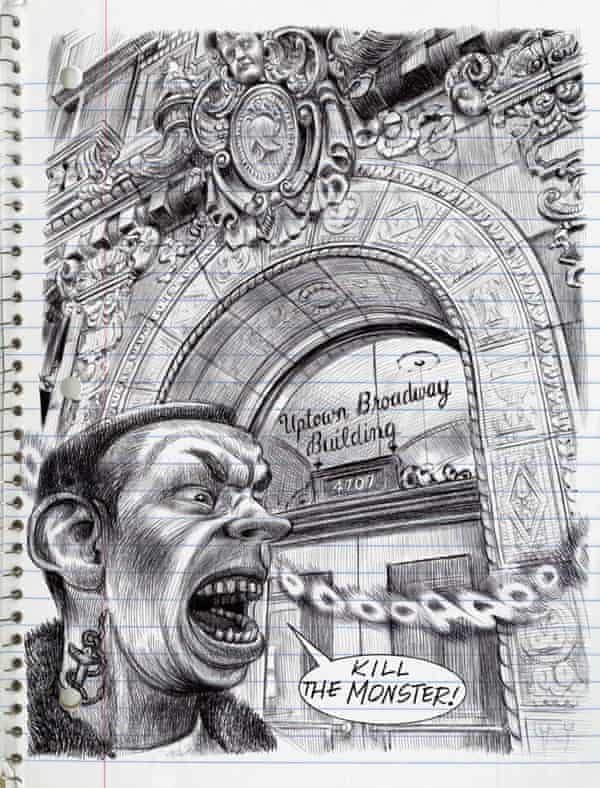
T here has never been a debut graphic novel quite like Emil Ferris's My Favorite Matter Is Monsters. The 55-year-old creative person's first published work, which came out concluding week, is a sweeping 60s-era murder mystery set in the cartoonist's native Chicago. It'south equanimous of ballpoint pen drawings on broad-ruled notebook paper and is the first half of the story with the second volume out in October. Before she began work on Monsters, Ferris paid the bills with freelance work as an illustrator and a toy designer, making figurines for McDonald's – she sculpted the Mulan line of Happy Meal prizes for one of the fast food behemoth's subcontractors – and for Tokyo toymaker Tomy, for whom she worked making the Tea Bunnies line of dolls.
But in 2001, Ferris contracted West Nile virus. At the fourth dimension a 40-twelvemonth-old single mother, Ferris's work was all freelance, she said – with the effects of west Nile hindering the utilise of three of her limbs, her piece of work dried upward, and she looked for some other outlet, in part for her artistic output, and in part to practice a ascendant hand damaged past the effects of the disease. She went back to schoolhouse and produced My Favorite Thing Is Monsters, which draws on her own childhood and on the experiences of family unit and friends who survived the Holocaust. But when her book was finished the Chinese company shipping the copies from the printer in South Korea to the United States went bankrupt and the whole impress run was held hostage at the Panama Canal by the aircraft company's creditors along with the rest of the cargo on the transport conveying it.
Now, it is finally hither.
When did you lot start drawing?
Probably when I was an infant, because my parents were both artists, and it was necessary to depict. My parents met at the Art Institute of Chicago as students, and somewhere in there they procreated off to the side and created me. My mother's line was always, "I met him, and I said, 'If you lot'll stretch my canvases I'll make clean your brushes.'"
Did you spend much time at the institute?
Going to the Fine art Institute was like [the mode] nigh families go to church. You went there for your religious pedagogy. We sort of memorized paintings the way other kids memorized Bible verses. We had to know what was in the right quadrant.

Your parents were both artists?
While [my father] was in high school he began making eight-pagers of Minnie and Mickey – he was an enterprising young human – and he was copying them out on the school's mimeograph automobile, and he got defenseless. And they were in the process of expelling him because these were highly pornographic, and the art teacher happened to see it and said, "Well, yous could expel him, merely I think he has talent, then let me have him." He was a groovy man. He was i of the great people. He taught me stealth drawing, which was where a lot of the information for the faces [in my book] comes from. Then nosotros would get on the Fifty train and he would take out his sketchbook, I would have out mine and we would find a person to draw unbeknownst to the person.
When did you contract Westward Nile virus?
I was a single parent at the time and I was trying to support my daughter then I was working at night and taking care of her during the 24-hour interval. Information technology was pretty rough. Then when she was six or seven years sometime, I was bitten by a mosquito, and I contracted West Nile virus, and inside 3 weeks I was completely paralyzed from the waist downwardly and I lost the use of my right mitt. So that's what happened, and that's why I concluded up in school [for writing at the Fine art Institute], because I realized I didn't have the ability to draw whatever more and I had to go on on going. I had to find something else.
What was the biggest effect information technology had on your work?
The hardest thing is in terms of the drawing, because, you know, I really have to work to keep my hand fluid and I've washed a lot of recovery, merely information technology's not the same as it once was. There's a lot of joy in drawing the volume, because I started the book yet with some difficulties from paralysis, and the volume was office of what helped me recover.
Take you always used storytelling in your life?
When I was a child I had this astringent disability, then I was the kid in the playground who wasn't running. I had a spinal curvature, some amount of hunchback, two unlike lengths of leg, only I learned – and this is what's then interesting about the globe – I learned the my story-telling [of] horror and ghost stories would get a oversupply of ten kids effectually me. And so I was not solitary. I learned how not to be alone in the playground. They would all show up for the side by side installment – of course I would e'er get out information technology hanging anywhere I could, so I could be bodacious that the adjacent installment would be something they were looking forward to, because I didn't want to be alone.
Why draw the protagonist Karen as a werewolf?
I drew her the style I saw myself, the style I felt I was. I drew her the mode I wanted to be. My mother was very, very beautiful, and I saw that the beautiful women around me were often constrained not only by their beauty but by the style that being an object of male person desire frequently caused violence in their lives. And it caused them to exist constrained in these terribly deplorable means – their brilliance was non valued. They weren't socially valued at the fourth dimension, either.
Then, and the second volume really does deal with this, I didn't ever want to be a woman. I mean, it just did not expect like a good thing, nor did beingness a human, considering it felt like they were beingness victimized by the aforementioned system. It didn't give them much more than latitude than they gave women, in many means. They were being constrained to acquit in these ways that weren't accurate and didn't allow them to realize their total personhood, either. Being a monster seemed like the absolute best solution.
Who would you say influenced you?
[As a kid] I had been seeing an awful lot of Goya, and Daumier, and so when I was about eight years old my grandmother in New Mexico, who was a very literate person, began sending me the Collier's Illustrated Dickens, and if I read one she would send me another 1. They were big and fat and thick and had these beautiful illustrations, beautiful engravings. I just wanted that experience: to write stories where the drawings were that articulated and atmospheric.
Any gimmicky cartoonists?
Well, the whole circle comes around: at [The Miami Book Fair] I got to encounter Art Spiegelman. And then I saturday downward at a demote and I'k looking at this guy who's sitting across from me. He introduces himself and says his name is Dean Haspiel and I said, "Oh, okay," and shook his hand. I felt similar people were looking at me and thinking, "Oh, a footling quondam lady, what did she write?" I'm sure that's what people thought. And I have crumbs on my face from the empanadas and am totally a train wreck and he says, "What did you write?" And I said, "I wrote this volume," and he looks at me, with this blinking face, like he was trying to put me together with this book. So he turns to this guy next to him – he doesn't even say anything to me – and he whispers to this guy, and that guy turns around and looks at me with the same expression, rima oris open, blink glimmer, and that guy puts his manus out and says, "I'm Charlie, I work at Adams, I remember y'all want to meet somebody."
So he turns over to this other guy, this guy looks similar some kind of very distinguished member of the intelligentsia of Weimar Berlin. He's vaping in this very elegant mode. The smoke is abaft out of his mouth. He'south got this wait similar he's weighing the departure betwixt Freud and Jung right there in front of him. And Charlie says something to him, and so this weird matter happens: He just reaches beyond the tabular array and grabs my hand and says, "I'one thousand Fine art Spiegelman and I loved your book," and then I started crying like a large dumb infant. It was absolutely the craziest matter.
macphersonmakeekly.blogspot.com
Source: https://www.theguardian.com/books/2017/feb/20/emil-ferris-my-favorite-thing-is-monsters-graphic-novel
0 Response to "My Favorite Things Is Monsters Most Important Reviews"
Post a Comment